Image Map
Showing posts with label human rights. Show all posts

Thursday, August 12, 2010

Report: Military Assistance and Human Rights: Colombia, U.S. Accountability, and Global Implications

U.S. military aid flowing to Colombia is having a direct, negative effect on the human rights of Colombians. Though the “Leahy Law” prohibits aid to military units that have committed gross violations, the United States continues to support such units in Colombia. Worse, areas where Colombian army units received the largest increases in U.S. assistance reported increased extrajudicial killings on average.
You can read the executive summary below or download the full 51 page report (PDF, 1.4 MB).
The scale of U.S. training and equipping of other nations’ militaries has grown exponentially since 2001, but there are major concerns about the extent to which the U.S. government is implementing the laws and monitoring the impact its military aid is having on human rights. This report by the Fellowship of Reconciliation (FOR) and U.S. Office on Colombia examines these issues through a detailed case study of U.S.military aid, human rights abuses, and implementation of human rights law in Colombia.
28
U.S. Military Assistance to the Colombian Army
The experience of US military funding to Colombia shows alarming links between Colombian military units that receive U.S. assistance and civilian killings committed by the army. To prevent similar errors in Afghanistan and Pakistan, relevant Congressional committees and the State Department Office of the Inspector General must thoroughly study the Colombia case and implementation of U.S. law designed to keep security assistance from going to security force units committing gross human rights violations.

Tuesday, November 24, 2009

U.S. won't join landmine ban, administration decides

Washington (CNN) -- The United States won't join its NATO allies and many other countries in formally banning landmines, State Department spokesman Ian Kelly said during his midday briefing Tuesday.

"This administration undertook a policy review and we decided our landmine policy remains in effect," Kelly said in response to a question. "We made our policy review and we determined that we would not be able to meet our national defense needs nor our security commitments to our friends and allies if we sign this convention."

Opponents of the U.S. landmine policy said they were surprised.

"It is a disturbing development," said Steve Goose of Human Rights Watch. "The administration never said a policy review was under way."

Goose said the decision to leave the policy in place is at odds with the administration's professed commitments to international agreements and humanitarian issues.

"The international treaty against landmines has made a a huge difference and it is a very strong deterrent," Goose said. "It has to have been a very fast and cursory review."

The United States will attend an international conference on landmines next week in Cartagena, Colombia, sending an inter-agency delegation from the State and Defense departments as observers.

Kelly said the United States continues to work with governments as well as nongovernmental organizations (NGOs) to help remove landmines.

"The U.S. is proud to be the world's single largest supporter of humanitarian mine action," Kelly said. "Since 1993 the U.S. has provided more than $1.5 billion worldwide dedicated to building new partnerships with more than 50 post-conflict countries and supporting efforts by dozens of NGOs to promote stability and set the stage for recovery and development through mine clearance and conventional-weapons destruction programs."

The United States is the only member of NATO that will not sign the landmine treaty, Goose said. Russia and China also have not joined the 156 nations that have endorsed the ban, he said.

Sunday, January 22, 2006

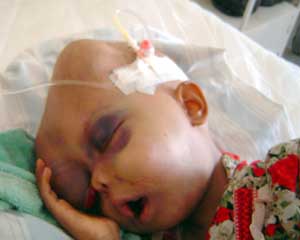
DISTURBING PHOTOS: Nothing depleted about 'depleted uranium'


du-baby18.jpg


Iraqi and visiting doctors, and a number of news reports, have reported that birth defects and cancers in Iraqi children have increased five- to 10-fold since the 1991 Gulf War and continue to increase sharply, to over 30-fold in some areas in southern Iraq. Currently, more than 50 percent of Iraqi cancer patients are children under the age of 5, up from 13 percent. Children are especially vulnerable because they tend to play in areas that are heavily polluted by depleted uranium.

The Pentagon has been using radiooactive weapons for at least a decade and a half with full complicity of at least three White House administrations and Republican and Democratic congressional legislators. Conservatively, at least 300 tons and 1,700 tons of depleted uranium were used in the Gulf War and the current Iraq War, resectively. This is about 70 grams of depleted uranium per Iraqi citizen, and if inhaled or ingested, it is enough to kill them all.

Is this not radioactive genocide, especially when our troops used and continue to use most of the depleted uranium munitions in densely populated areas such as Baghdad and Fallujah? Depleted uranium has a half-life of billions of years. Consequently, Iraq will be a wasteland forever and essentially uninhabitable for anyone.