Image Map
Showing posts with label iraq. Show all posts

Saturday, July 24, 2010

Toxic legacy of US assault on Fallujah 'worse than Hiroshima'

http://www.independent.co.uk/news/world/middle-east/toxic-legacy-of-us-assault-on-fallujah-worse-than-hiroshima-2034065.html


By Patrick Cockburn
The shocking rates of infant mortality and cancer in Iraqi city raise new questions about battle
Dramatic increases in infant mortality, cancer and leukaemia in the Iraqi city of Fallujah, which was bombarded by US Marines in 2004, exceed those reported by survivors of the atomic bombs that were dropped on Hiroshima and Nagasaki in 1945, according to a new study.
Iraqi doctors in Fallujah have complained since 2005 of being overwhelmed by the number of babies with serious birth defects, ranging from a girl born with two heads to paralysis of the lower limbs. They said they were also seeing far more cancers than they did before the battle for Fallujah between US troops and insurgents.
Their claims have been supported by a survey showing a four-fold increase in all cancers and a 12-fold increase in childhood cancer in under-14s. Infant mortality in the city is more than four times higher than in neighbouring Jordan and eight times higher than in Kuwait.

Wednesday, May 26, 2010

NO JOKE: CIA Had Plan to Portray Saddam Hussein as Pedophile

(May 25) -- The CIA had a bag of dirty tricks ready for Saddam Hussein in preparation of the 2003 American invasion of Iraq that included making him look like a pedophile. It also had something similar planned for Osama bin Laden.

The Washington Post blog Spy Talk, citing former CIA officials, said one devious tactic involved creating a video showing the Iraqi strongman purportedly having sex with a teenage boy.

"It would look like it was taken by a hidden camera," one ex-CIA official told Spy Talk's Jeff Stein. "Very grainy, like it was a secret videotaping of a sex session."


Saturday, April 24, 2010

Yes, We Could... Get Out! Why We Won’t Leave Afghanistan or Iraq


By Tom Engelhardt
Yes, we could. No kidding. We really could withdraw our massive armies, now close to 200,000 troops combined, from Afghanistan and Iraq (and that’s not even counting our similarly large stealth army of private contractors, which helps keep the true size of our double occupations in the shadows). We could undoubtedly withdraw them all reasonably quickly and reasonably painlessly.
Not that you would know it from listening to the debates in Washington or catching the mainstream news. There, withdrawal, when discussed at all, seems like an undertaking beyond the waking imagination. In Iraq alone, all those bases to dismantle and millions of pieces of equipment to send home in a draw-down operation worthy of years of intensive effort, the sort of thing that makes the desperate British evacuation from Dunkirk in World War II look like a Sunday stroll in the park. And that’s only the technical side of the matter.
Then there’s the conviction that anything but a withdrawal that would make molasses in January look like the hare of Aesopian fable -- at least two years in Iraq, five to ten in Afghanistan -- would endanger the planet itself, or at least its most important country: us. Without our eternally steadying hand, the Iraqis and Afghans, it’s taken for granted, would be lost. Without the help of U.S. forces, for example, would the Maliki government ever have been able to announce the death of the head of al-Qaeda in Iraq? Not likely, whereas the U.S. has knocked off its leadership twice, first in 2006, and again, evidently, last week.
Of course, before our troops entered Baghdad in 2003 and the American occupation of that country began, there was no al-Qaeda in Iraq. But that’s a distant past not worth bringing up. And forget as well the fact that our invasions and wars have proven thunderously destructive, bringing chaos, misery, and death in their wake, and turning, for instance, the health care system of Iraq, once considered an advanced country in the Arab world, into a disaster zone(that -- it goes without saying -- only we Americans are now equipped to properly fix). Similarly, while regularly knocking off Afghan civilians at checkpoints on their roads and in their homes, at their celebrations and at work, we ignore the fact that our invasion and occupation opened the way for the transformation of Afghanistan into the first all-drug-crop agricultural nation and so the planet's premier narco-nation. It’s not just that the country now has an almost total monopoly on growing opium poppies (hence heroin), but according to the latest U.N. report, it’s now cornering the hashish market as well. That’s diversification for you.

Monday, April 19, 2010

Soldiers in "WikiLeaks" Unit Apologize for Violence + VIDEO


Editor's Note: The WikiLeaks "Collateral Murder" video shook an apathetic and misled public awake with images of civilian killing in the chaotic streets of Baghdad in July 2007. US forces wounded two small children and killed over a dozen people including members of the media. Two soldiers from the company involved in the shooting incident have written a letter of reconciliation and apology to the people affected by the incident, which is published below. -Matt Renner.
An Open Letter of Reconciliation and Responsibility to the Iraqi People: From Current and Former Members of the US Military
Peace be with you,
To all of those who were injured or lost loved ones during the July 2007 Baghdad shootings depicted in the "Collateral Murder" Wikileaks video:

Wednesday, April 7, 2010

Iraq War Vet: "We Were Told to Just Shoot People, and the Officers Would Take Care of Us"


On Monday, April 5, Wikileaks.org posted video footage from Iraq, taken from a US military Apache helicopter in July 2007 as soldiers aboard it killed 12 people and wounded two children. The dead included two employees of the Reuters news agency: photographer Namir Noor-Eldeen and driver Saeed Chmagh.
The US military confirmed the authenticity of the video.
The footage clearly shows an unprovoked slaughter, and is shocking to watch whilst listening to the casual conversation of the soldiers in the background.
As disturbing as the video is, this type of behavior by US soldiers in Iraq is not uncommon.
Truthout has spoken with several soldiers who shared equally horrific stories of the slaughtering of innocent Iraqis by US occupation forces.
"I remember one woman walking by," said Jason Washburn, a corporal in the US Marines who served three tours in Iraq. He told the audience at the Winter Soldier hearings that took place March 13-16, 2008, in Silver Spring, Maryland, "She was carrying a huge bag, and she looked like she was heading toward us, so we lit her up with the Mark 19, which is an automatic grenade launcher, and when the dust settled, we realized that the bag was full of groceries. She had been trying to bring us food and we blew her to pieces."

Saturday, January 2, 2010

Iraqis Angered as Blackwater Charges Are Dropped


BAGHDAD — Iraqis on Friday reacted with disbelief, anger and bitter resignation to news that criminal charges in the United States had been dismissed against Blackwater security guards who opened fire on unarmed Iraqi civilians in 2007 in a fusillade that left 17 dead.
“What are we — not human?” asked Abdul Wahab Adul Khader, a 34-year-old bank employee and one of at least 20 people wounded in the melee. “Why do they have the right to kill people? Is our blood so cheap? For America, the land of justice and law, what does it mean to let criminals go?”
The Iraqi government, meanwhile, expressed its “regrets” about the ruling.
The problem with the court case, according to the federal judge who issued the ruling, was that statements given by the five Blackwater guards had been improperly used, compromising their right to a fair trial.
The judge, Ricardo M. Urbina, threw out manslaughter and weapons charges against the guards on Thursday, ruling that the case had been improperly built, in part, on sworn statements that they had given to the State Department under the promise of immunity.
Prosecutors have not said whether they will appeal the decision.The shooting, a signal event of the war here, helped calcify anti-American sentiment in Iraq and elsewhere.
It also raised Iraqi concerns about the extent of its sovereignty because Blackwater guards had immunity from local prosecution, and stoked a debate about American dependence on private security contractors in the Iraq war.
Many Iraqis also viewed the prosecution of the guards as a test case of American democratic principles, which have not been wholeheartedly embraced, and in particular of the fairness of the American judicial system.
The ruling on Thursday appeared to confirm the feelings of some that their skepticism had been justified. For Iraqis directly affected by the violence, the result was incomprehensible.
Some victims and their families said they did not understand how charges could have been dropped despite what they regarded as overwhelming evidence.

Wednesday, November 11, 2009

Blackwater Said to Pursue Bribes to Iraq After 17 Died


WASHINGTON — Top executives at Blackwater Worldwide authorized secret payments of about $1 million to Iraqi officials that were intended to silence their criticism and buy their support after a September 2007 episode in which Blackwater security guards fatally shot 17 Iraqi civilians in Baghdad, according to former company officials.
Blackwater approved the cash payments in December 2007, the officials said, as protests over the deadly shootings in Nisour Square stoked long-simmering anger inside Iraq about reckless practices by the security company’s employees. American and Iraqi investigators had already concluded that the shootings were unjustified, top Iraqi officials were calling for Blackwater’s ouster from the country, and company officials feared that Blackwater might be refused an operating license it would need to retain its contracts with the State Department and private clients, worth hundreds of millions of dollars annually.
Four former executives said in interviews that Gary Jackson, who was then Blackwater’s president, had approved the bribes and that the money was sent from Amman, Jordan, where the company maintains an operations hub, to a top manager in Iraq. The executives, though, said they did not know whether the cash was delivered to Iraqi officials or the identities of the potential recipients.

Saturday, November 7, 2009

Iraq oil prize for Exxon, Shell

Martin Chulov, Baghdad
November 7, 2009 - 12:05AM
AMERICAN energy giant ExxonMobil and Europe-based Shell have won the right to develop one of the world's most prized untapped oil reserves.
The $US50 billion ($A55 billion) deal will place them among the largest players in postwar Iraq.
The energy companies were awarded the contract to extract oil from the West Qurna reservoir near Basra in Iraq's south in an extended tender process that has seen the Iraqi Government partner foreign companies in a bid to get its reserves of oil out of the ground as quickly and cheaply as possible. West Qurna was considered the jewel among the nine Iraqi oil and gas fields up for grabs, with verified reserves of 15 billion barrels and a strong chance that exploration will reveal significantly more.
Oil Minister Hussain Shahristani said the contract stipulated a $US25 billion investment and $US25 billion more in operating fees. It is expected to yield up to 100,000 jobs in the impoverished deep south of the country that has been heavily blighted by insurgency in the past five years.

Sunday, January 22, 2006

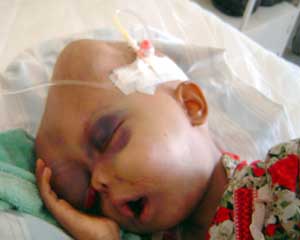
DISTURBING PHOTOS: Nothing depleted about 'depleted uranium'


du-baby18.jpg


Iraqi and visiting doctors, and a number of news reports, have reported that birth defects and cancers in Iraqi children have increased five- to 10-fold since the 1991 Gulf War and continue to increase sharply, to over 30-fold in some areas in southern Iraq. Currently, more than 50 percent of Iraqi cancer patients are children under the age of 5, up from 13 percent. Children are especially vulnerable because they tend to play in areas that are heavily polluted by depleted uranium.

The Pentagon has been using radiooactive weapons for at least a decade and a half with full complicity of at least three White House administrations and Republican and Democratic congressional legislators. Conservatively, at least 300 tons and 1,700 tons of depleted uranium were used in the Gulf War and the current Iraq War, resectively. This is about 70 grams of depleted uranium per Iraqi citizen, and if inhaled or ingested, it is enough to kill them all.

Is this not radioactive genocide, especially when our troops used and continue to use most of the depleted uranium munitions in densely populated areas such as Baghdad and Fallujah? Depleted uranium has a half-life of billions of years. Consequently, Iraq will be a wasteland forever and essentially uninhabitable for anyone.